
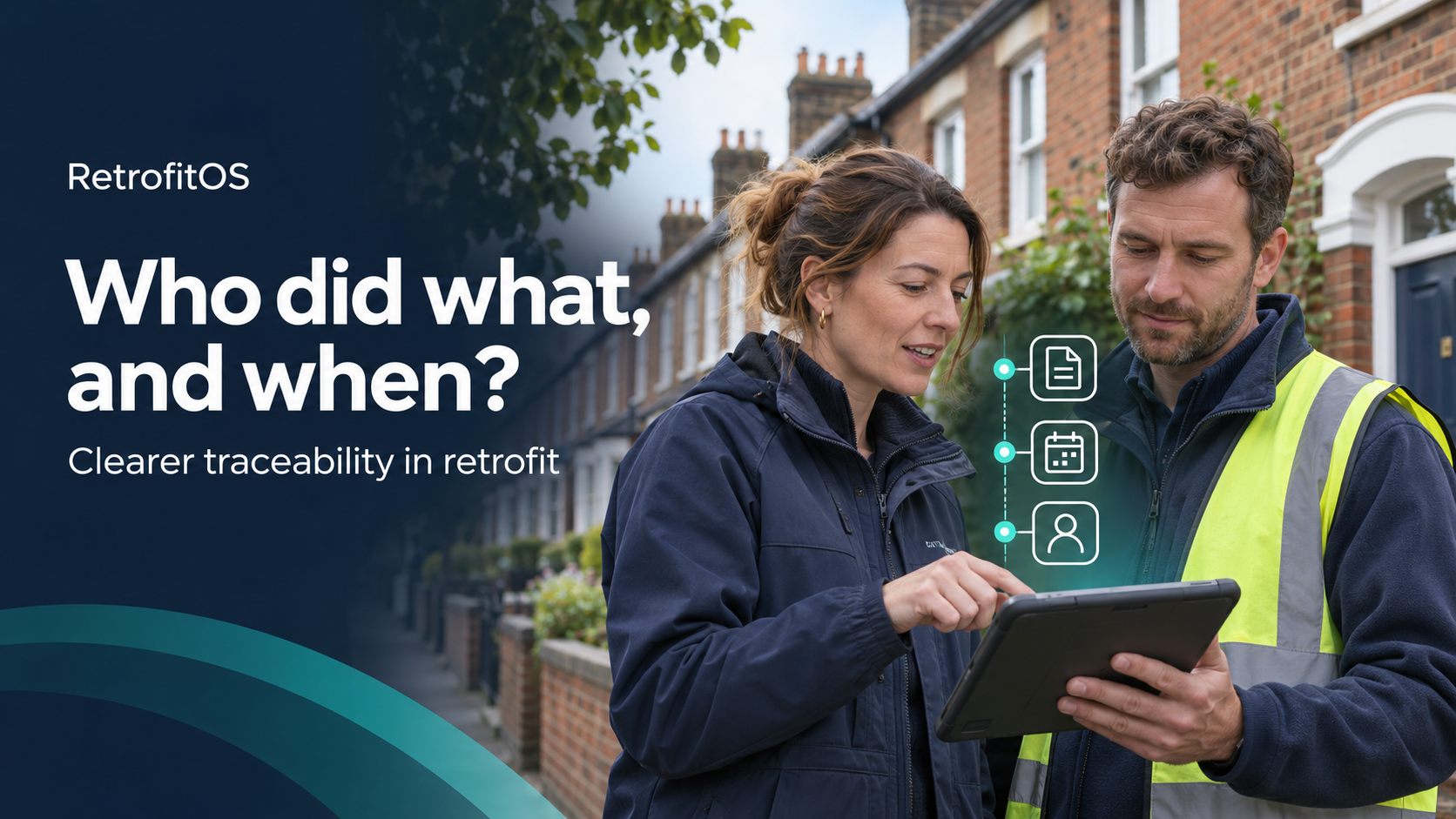
A document has been uploaded. An appointment has taken place. A project has moved to its next stage.
Each action tells part of the story of a retrofit project. Across hundreds of properties, multiple organisations and different professional roles, being able to follow that story becomes essential.
When a question arises, teams need to establish what happened, when it happened and who was involved. Reconstructing events through inboxes, spreadsheets and separate folders takes time—and can leave important gaps.
Recent investigations and consultations have highlighted weaknesses in the sector’s oversight, information and accountability arrangements. For organisations delivering retrofit, these findings raise a practical question: how easily can you explain the history of the work being carried out across your programme?
What the sector’s reviews highlighted
The National Audit Office’s October 2025 report, Energy efficiency installations under the Energy Company Obligation, identified failures in the design and operation of ECO4 and the Great British Insulation Scheme’s consumer protection and quality assurance arrangements.
Its findings included weak oversight, fragmented responsibilities and inadequate audit and monitoring. Significant installation-quality problems were not brought to government’s attention early enough, and the system left the Department for Energy Security and Net Zero with limited information and few mechanisms for intervention.[1]
These were findings about specific schemes and their assurance arrangements. They should not be read as a judgement on every retrofit project or delivery organisation. They do, however, underline the importance of accessible information and clear responsibility.
The government’s June 2026 consultation, Reforming Consumer Protection for Home Upgrade Schemes, subsequently identified incomplete and uncoordinated data, overlapping responsibilities and inconsistent assurance as root causes of problems. Its proposals include stronger accountability, improved data sharing and better use of information to identify risks earlier.[2]
TrustMark’s September 2026 consultation on proposed scheme changes similarly set out a direction towards stronger oversight, clearer accountability and greater use of job-level data in quality assurance.[3]
These consultations describe proposed reforms. They also provide a clear prompt for delivery teams to examine how information is recorded and used today.
The everyday challenge: understanding how a project reached its current position
For a housing association, principal contractor or retrofit coordinator, the need for traceability often starts with an ordinary operational question:
-
When was this document added?
-
Who updated the form?
-
What activity took place around the appointment?
-
When did the project progress?
-
What communications are recorded?
Answering these questions helps teams understand a project’s current position and decide what to investigate or do next.
A status alone gives limited context. Knowing that a project is at review is useful; being able to follow the activity leading up to that point provides a much clearer picture.
That context becomes particularly valuable when responsibility passes between colleagues or organisations. The person picking up a query may not be the person who handled the original work.
How enhanced activity logging in RetrofitOS helps
RetrofitOS brings activity history into the platform, recording activity across documents, forms, appointments, project progression and communications against the relevant records.
This gives teams a clearer basis for understanding what has happened and who was involved, helping them work with the information already captured during delivery.
Easier handovers
When a colleague takes over a project or responds to a query, activity history helps them establish the context.
They can review recorded events before deciding what needs attention, reducing dependence on the original team member’s recollection.
More informed investigations
When information is questioned or a discrepancy appears, the sequence of recorded activity can help a reviewer establish a timeline.
That supports more focused follow-up: identifying the relevant change, finding the people involved and understanding which evidence needs closer examination.
Better support for assurance reviews
Assurance relies on being able to examine evidence and understand the process around it.
Activity records provide supporting context for that review. They help teams trace actions across the project record and explain how work has progressed.
Less time reconstructing events
Searching separate systems for an upload date, appointment update or recorded communication adds administrative effort.
Making activity history accessible within the platform helps teams find context more efficiently and spend more time progressing work.
A practical example
Imagine a project manager receives a query about a property that has recently moved forward.
They need to establish when supporting documents were added, whether relevant form information changed and what appointment activity or communications were recorded.
An accessible activity history gives them a starting point for that investigation. They can follow the recorded sequence and direct their questions to the relevant people.
The documents still need professional review, and the work still needs appropriate inspection. The activity history helps the team understand the surrounding events.
Traceability supports quality—but quality still needs verification
A recorded upload establishes that a file was added. A recorded status change establishes that a project moved stage.
Neither action, by itself, demonstrates that the evidence is technically adequate or that the installation is satisfactory.
Effective assurance combines traceability with competent review, appropriate site checks, clear decisions and action when problems are identified.
At RetrofitOS, we see activity logging as an important foundation for that process: giving teams a clearer history to work from when they manage delivery, investigate questions and support oversight.
Making accountability part of everyday delivery
The sector’s reviews highlight the consequences of information gaps and unclear responsibilities. Addressing those challenges involves government, assurance bodies, delivery organisations and individual professionals.
For project teams, a practical step is to make the history of delivery easier to follow.
Who acted? What changed? When did it happen?
Being able to answer those questions helps teams collaborate, investigate issues and explain their work with greater confidence.
Want a clearer view of activity across your retrofit programmes? Speak to the RetrofitOS team to see enhanced activity logging in action.
References
[1] National Audit Office — Energy efficiency installations under the Energy Company Obligation, 14 October 2025. See the report’s conclusions and discussion of the root causes of quality failures.
Read the NAO report
[2] Department for Energy Security and Net Zero — Reforming Consumer Protection for Home Upgrade Schemes, published 17 June 2026. See Chapter 1, “The case for change”, and Chapter 3 on oversight, accountability and data.
Read the government consultation
[3] TrustMark — Proposed Scheme Changes: Public Consultation Document, published 22 September 2026. See the executive summary and sections on extended Data Warehouse lodgement, quality assurance and accountability.
Visit TrustMark’s proposed scheme changes information