
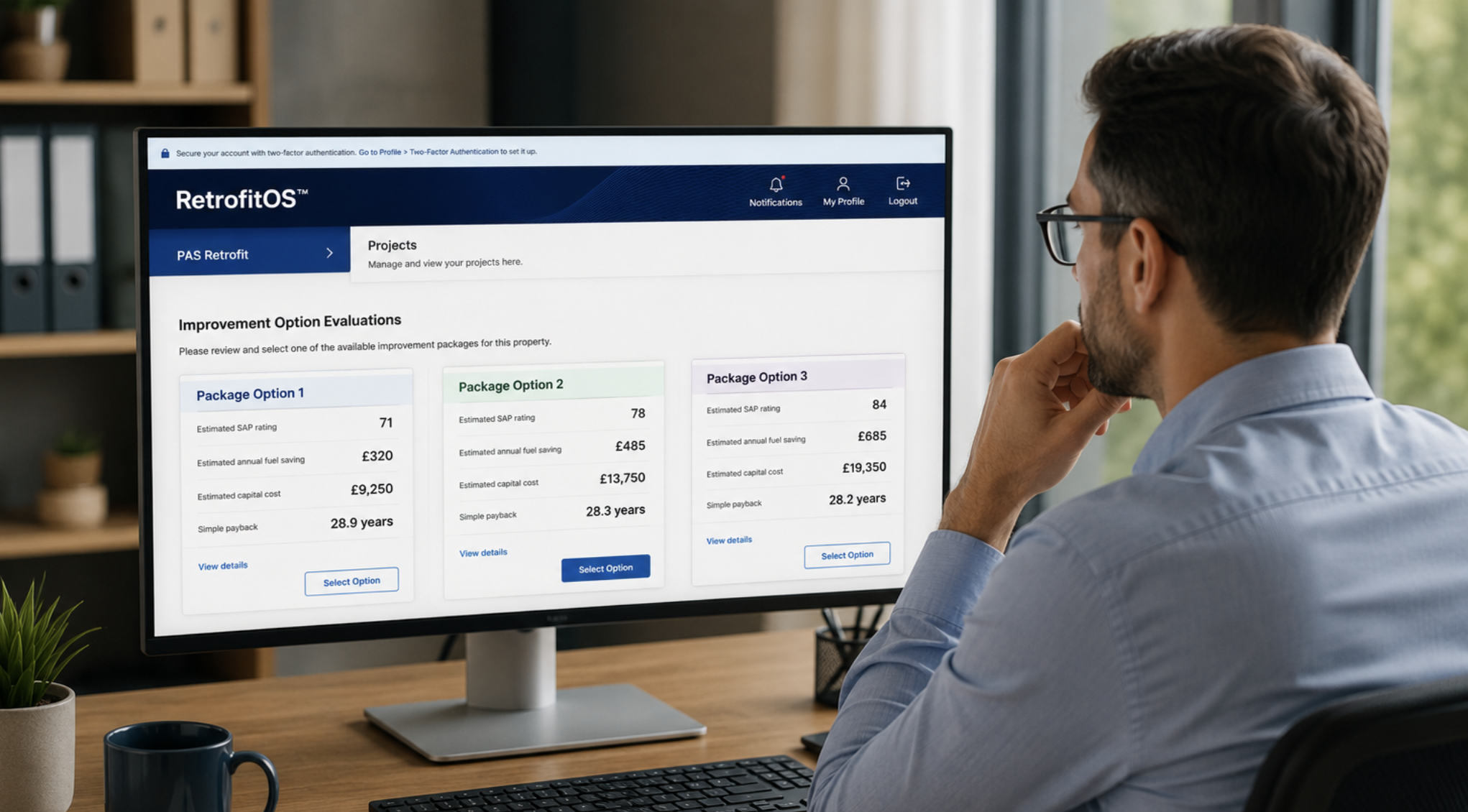
Completing an Improvement Option Evaluation is not simply a technical exercise.
It is the point at which evidence about a property must be translated into a practical decision: which measures should be installed, which should be deferred, what investment is required, and what outcome the proposed package is expected to achieve for the home and its resident.
That decision should not sit in isolation with one individual. Nor should it disappear into a chain of emails, spreadsheets and attachments that different members of the delivery team interpret in different ways.
RetrofitOS creates a clear, controlled route from technical evaluation to informed client approval.
From improvement options to an informed decision
Once the Retrofit Coordinator has completed the Improvement Option Evaluation, the proposed package options can be sent directly through RetrofitOS to a selected individual for review.
That person(s) may be part of a Housing Association, Local Authority, Principal contractor, managing agent or another organisation responsible for approving the planned investment.
They can choose to receive an email notification confirming that the evaluation has been completed and that the available package options are ready to review.
From there, they can access the relevant information, compare the available packages and select the option that should progress towards installation.
It is a simple interaction, but it provides a clear answer to one of the most important questions in retrofit delivery:
Who reviewed the proposed package, and who formally decided that it was the right one to install?
With RetrofitOS, the decision is visible, connected and recorded.
Reviewing more than a list of measures
A package decision should involve far more than reading the names of the proposed measures.
An Improvement Option Evaluation brings together information about the improvements planned to increase the energy efficiency of the home, alongside additional measures that could be explored in the future.
Through RetrofitOS, the reviewer can quickly understand each option in context, including:
- The measures included within the proposed package
- Measures that could form part of a medium-term improvement plan
- The anticipated SAP and EPC outcome
- The estimated capital cost
- The projected annual fuel saving
- The simple payback period
- The predicted lifetime fuel saving
- The lifetime carbon saving
- The carbon cost-effectiveness
- The effect on space-heating demand
- The proposed sequencing of measures
This allows the approving organisation to look beyond whether a measure is technically possible and consider whether the proposed combination is appropriate for the property, the resident, the programme and the available budget.
The evaluation can also show the expected effect of individual measures when modelled independently. In the example reviewed for this article, separate information was provided for ventilation, an air-source heat pump, loft insulation, external wall insulation, solar photovoltaics and battery storage, including the projected SAP rating, cost, fuel saving, payback and carbon performance of each option.
That gives the reviewer a far stronger basis for decision-making than a brief recommendation contained within an email.
Understanding the proposed outcome before installation
The package view allows the client to understand what each proposed combination of measures is expected to achieve when considered as a whole.
This gives the Housing Association, Local Authority or Tier 1 contractor a much stronger basis for deciding what should progress.
The importance is not simply that the information exists. It is that RetrofitOS places it in front of the right person, at the right time, through a clear notification and review process.
Before installation begins, the approving organisation can ask:
Does this package achieve the intended energy-performance objective?
Is the investment proportionate to the anticipated benefit?
Should any measures be deferred to a later phase?
Does the proposal reflect the condition of the property and the circumstances of the resident?
Are the sequencing and enabling works appropriate?
These are technical, financial and governance decisions. RetrofitOS helps ensure they are made visibly and deliberately rather than becoming buried within disconnected documents and email chains.
Why greater client oversight matters
Housing Associations and Local Authorities are responsible for far more than administering individual retrofit projects.
They are making long-term decisions about their homes, their residents and the use of significant public and organisational investment.
They need confidence that the right work is being carried out on the right properties, for the right reasons.
Without a connected process, the client can become too distant from the point at which a technical recommendation becomes an installation decision. They may receive reports after packages have already been progressed, or rely on information distributed across documents, meetings and email threads.
RetrofitOS brings the client directly into the decision-making process.
It gives the relevant organisation the opportunity to review the Improvement Option Evaluation before the package is confirmed, rather than simply receiving a retrospective report on what has already been selected.
This creates stronger oversight of individual properties and a clearer view of delivery across the wider housing stock.
For Housing Associations and Local Authorities, that means greater control over:
- Which packages are approved
- How available funding is allocated
- The outcomes being pursued across different properties
- The consistency of decision-making across the programme
- The measures being deferred to future phases
- The evidence supporting each investment decision
- The point at which a property is permitted to progress
That oversight becomes increasingly important as programmes grow in scale.
A process that appears manageable across ten properties can quickly become fragmented across hundreds or thousands. RetrofitOS provides the structure needed to maintain visibility and control without creating unnecessary administration for the people delivering the programme.
Property-specific advice remains part of the decision
Retrofit decisions cannot be made from headline EPC and financial figures alone.
The condition, construction and ventilation requirements of the property must also be considered.
The example evaluation included advisory notes identifying the need for suitable kitchen extract ventilation, additional background ventilation within habitable rooms and six door undercuts to support an effective ventilation strategy.
This is important because an improvement package is not simply a collection of products.
Measures interact with the building fabric, the ventilation strategy, the heating system and the way the home is occupied. A package that looks attractive from a headline energy perspective may still require careful consideration of sequencing, enabling works and resident circumstances.
By keeping this information connected to the package review, RetrofitOS helps clients make decisions with a fuller understanding of the property.
Slick communication without fragmented administration
In many retrofit programmes, the technical work may be robust while the communication surrounding it remains fragmented.
A Retrofit Coordinator completes the evaluation.
A document is exported.
An email is written.
Someone downloads the attachment.
Questions are raised in a separate thread.
A decision is discussed during a meeting.
The outcome is eventually transferred into a spreadsheet or project tracker.
By the time the property reaches installation, it may no longer be clear which version was reviewed, which package was agreed or whether the final decision was formally recorded.
RetrofitOS replaces that fragmented journey with a controlled workflow:
The Retrofit Coordinator completes the evaluation.
The available packages are sent to the relevant decision-maker.
An email notification tells them that the information is ready.
They review the options and the supporting evidence.
They select the preferred package.
The decision becomes part of the property record.
The wider delivery team can see what has been agreed and progress the property accordingly.
The process feels straightforward because it should be straightforward. The complexity is managed within the platform rather than passed between organisations through avoidable administration.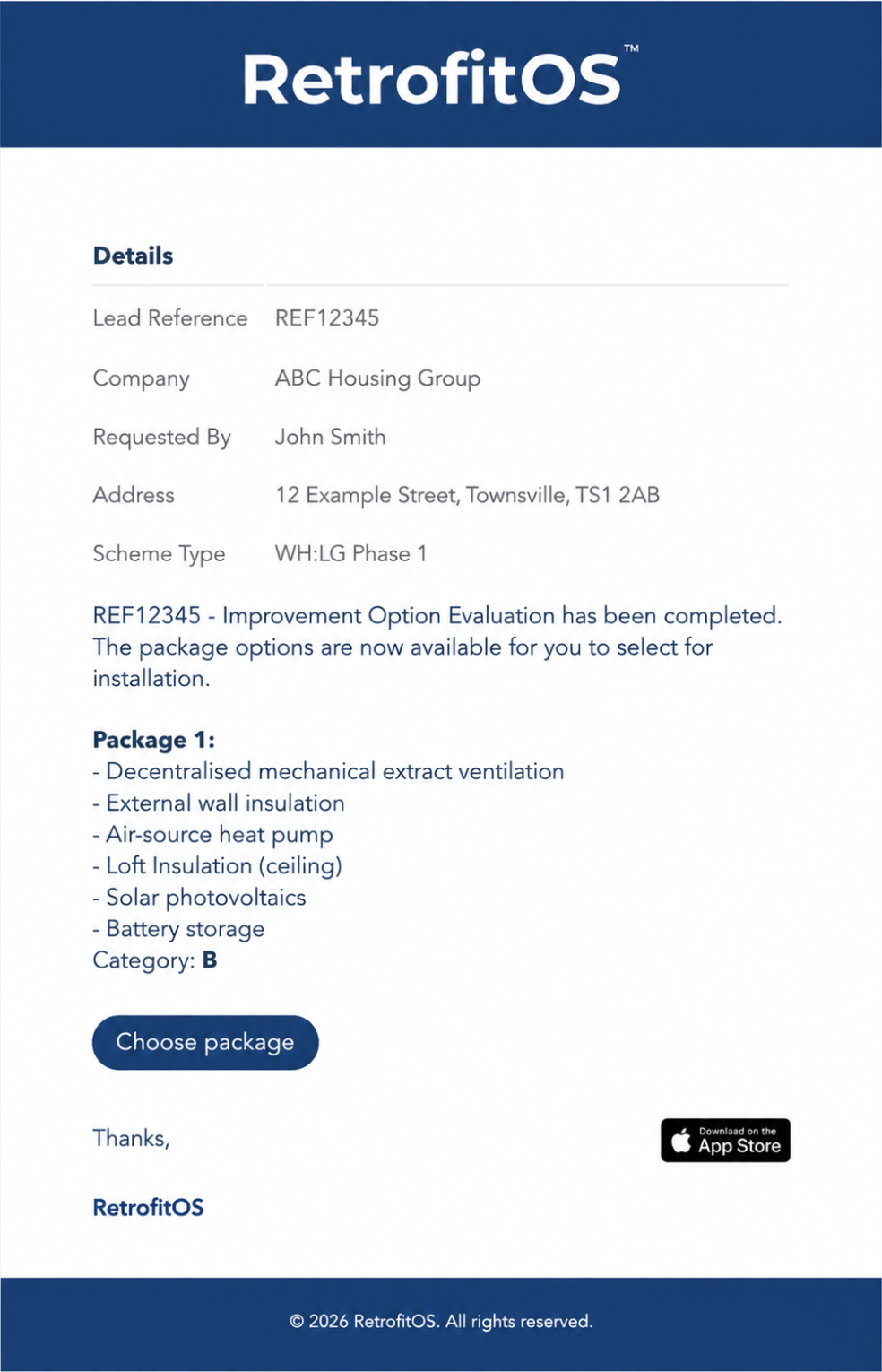
Connecting the whole delivery team
This feature demonstrates what RetrofitOS is designed to do.
It connects the people carrying out the technical work with the organisations responsible for investment, governance, delivery and resident outcomes.
The Retrofit Coordinator completes the Improvement Option Evaluation.
The Housing Association, Local Authority or relevant client reviews the evidence and selects the package.
The Tier 1 contractor and delivery partners can see what has been approved.
The design and installation teams can work from the same agreed position.
The programme team retains a clear record of the decision.
Everyone works from one shared source of information.
That is particularly important on large-scale retrofit programmes, where the quality of delivery depends not only on individual competence but on how effectively evidence, decisions and responsibilities move between different organisations.
RetrofitOS does not simply digitise the Improvement Option Evaluation.
It turns it into an active and connected stage of the delivery process.
Better governance, better delivery and better resident outcomes
Greater oversight is not about introducing another layer of approval for its own sake.
It is about ensuring that the people responsible for the housing stock have the opportunity to understand and influence what is being delivered.
It supports:
Stronger governance
The client can see the evidence behind the recommendation before the package is approved.
Clearer accountability
The selected option and the decision to progress it are recorded within the property journey.
Better financial control
Capital cost can be considered alongside energy, fuel-saving and carbon outcomes.
Greater consistency
A structured review and selection process can be applied across the whole programme.
Reduced delivery risk
Questions can be resolved before measures progress into design, procurement or installation.
Better asset intelligence
The organisation develops a clearer picture of what is being installed, what is being deferred and why.
Better outcomes for residents
The chosen package can be considered against the needs of the actual home and the people living within it, rather than being driven solely by programme-level targets.
A conversation we believe Housing Associations and Local Authorities should be having
At RetrofitOS, we believe Housing Associations and Local Authorities should have meaningful oversight at the point where technical options become delivery decisions.
They should be able to see what is being recommended across their housing stock, understand the expected outcome, question the proposal where necessary and formally confirm what should progress.
That level of control should not require the creation of more spreadsheets, more email chains or more manual reporting.
It should form part of the delivery process itself.
We are always happy to speak with Housing Associations, Local Authorities, combined authorities, Tier 1 contractors and programme partners about how this approach could support their existing delivery model.
That conversation may be about improving governance, creating greater visibility across the housing stock, strengthening the approval process or simply making it easier for the whole delivery team to work from the same information.
Every organisation will have its own structure, responsibilities and approval requirements. RetrofitOS provides the flexibility to connect those responsibilities within one controlled environment.
Options reviewed. Decisions connected.
The best time to identify a concern is before installation begins.
The best time to question a proposed package is before funds are committed.
And the best time to align the Retrofit Coordinator, client and wider delivery team is before different parts of the programme begin working from different assumptions.
By combining detailed Improvement Option Evaluation information with direct email notification, structured review and package selection, RetrofitOS gives organisations the visibility and control they need at precisely the right point in the process.
For Housing Associations, Local Authorities, Tier 1 contractors and programme partners delivering retrofit at scale, this is more than a convenient feature.
It is another step towards a more informed, accountable and connected model of retrofit delivery.
Options reviewed. Decisions connected. Delivery controlled.